



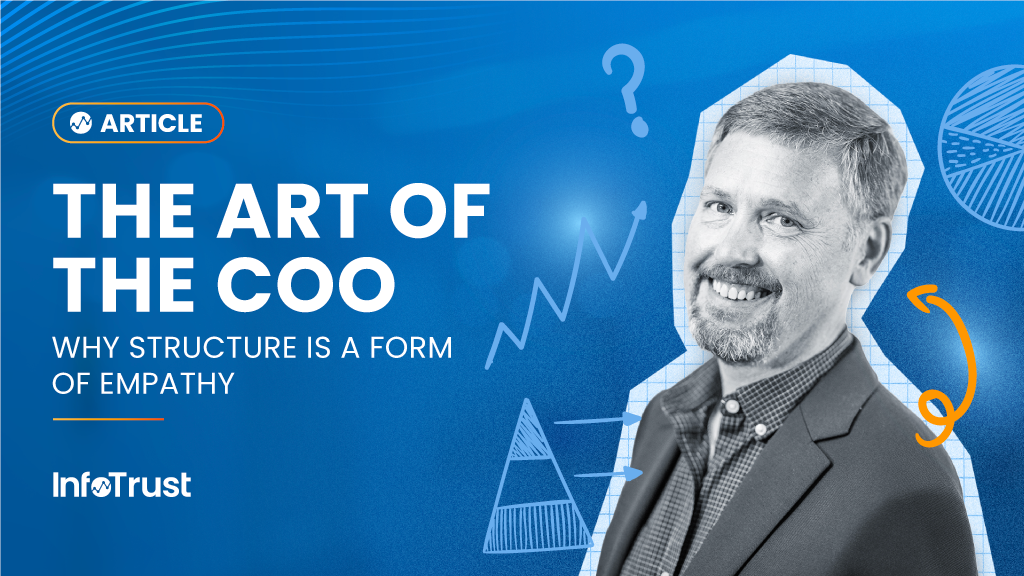
We often think of the role of a Chief Operating Officer as purely mechanical – someone who manages KPIs, enforces efficiency, and optimizes the bottom line. But after seven years working alongside Kent at InfoTrust, we’ve learned that true operational excellence is about far more than numbers. It is about managing energy, psychology, and, above all, humanity.
As Kent retires, I’ve spent time reading through reflections from our team. A clear pattern emerges: Kent didn’t just teach us how to work – he taught us how to think. As one colleague recalled, Kent shared an insight early on that shaped our culture: people management is more art than science.
What follows are three enduring lessons on the intersection of high performance and human nature that Kent leaves behind, shared in his own words and echoed by those he led.
1. Manage Energy, Not Just Time
In a world obsessed with productivity hacks and endless to-do lists, Kent introduced a different metric: brain cycles. He taught us that everyone has an optimal time of day when they do their best thinking – and that protecting that time is not a luxury, but a responsibility.
He normalized the biological reality that by the end of the day, we are often simply out of mental cycles. Rather than pushing through exhaustion, Kent gave us permission to stop when the tank was empty, trusting that we would return in the morning recharged and ready to go.
This wasn’t laziness. It was strategic sustainability – an acknowledgment that sustained high performance depends on respecting human limits.
2. Psychological Safety Fuels Speed
Many organizations stall not because of a lack of intelligence, but because people are afraid of being wrong. Kent reshaped our approach to decision-making with a simple mantra: No decision is still a decision – and most decisions can be walked back. Bias toward action.
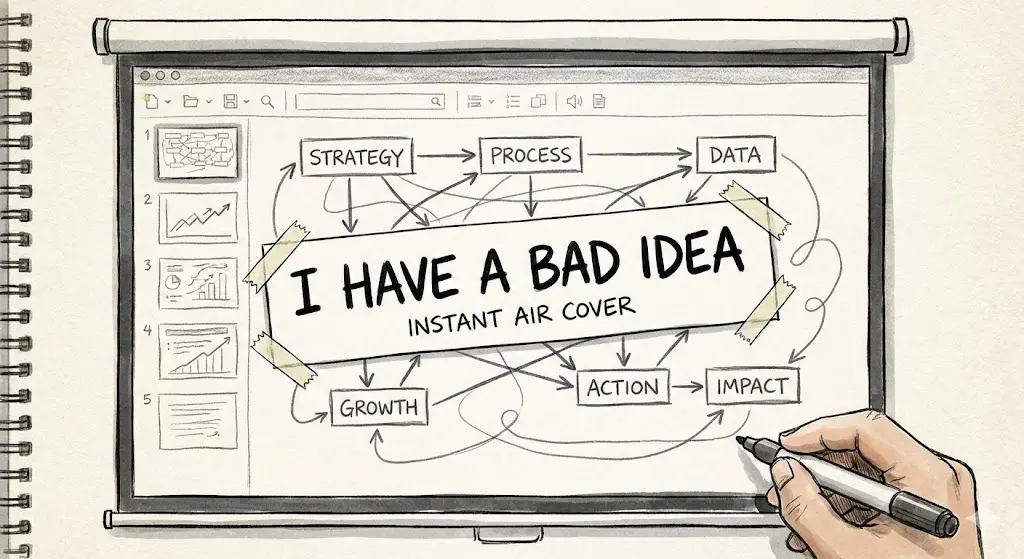
He even gave us the language to lower the stakes. One team member admitted, “I’ve definitely stolen ‘Here’s a bad idea’ and use it often.” That phrase created instant air cover. It removed friction, reduced fear, and made it safe to throw ideas into the room.
Kent showed us that sometimes making a decision acts as a forcing function. The value isn’t just in the choice itself, but in the momentum it creates – forcing conversations, surfacing constraints, and clarifying the path forward.
3. Structure Creates Clarity, Not Control
There is a common misconception that structure stifles creativity. Kent taught us the opposite: clarity often comes from structure and reflection.
Whether he was demonstrating how to analyze business data in a way that tells a meaningful story, or ensuring we had the right people in the right seats doing the right things for the right reasons, Kent showed us that frameworks exist to make sense of complexity – not to constrain it.
He taught us that structure helps us process information, challenge assumptions, and form more grounded points of view. In doing so, it creates freedom, not rigidity.
Voices from the Team
Kent’s impact wasn’t limited to strategy decks or operating models. It lived in the quiet moments of reassurance and perspective that shaped how people showed.
Before we say goodbye, I want to share a few reflections from his colleagues – direct echoes of his leadership that will remain in our hearts and minds.
On Focus
“You will go crazy trying to solve all the problems.” Kent taught us to focus on what we can actually impact and to dedicate energy to the few things that truly matter.
On Growth
He emphasized the order of operations – a reminder not to get ahead of ourselves about the future, but to focus on the steps required to reach it.
On Validation
One colleague shared a moment that became a turning point in their career. Kent told them simply, “People just enjoy working with you.” That small sentence gave them the confidence to double down on their core personality and fully embrace it.
On Anxiety and Turnover
“I remember when a long-time InfoTrust employee left. Kent helped us reframe the moment, reminding us that while every person matters, healthy organizations are designed to continue moving forward, even through change.”
If you look closely at these reflections, a common thread emerges: permission. Permission to be imperfect. Permission to rest. Permission to be human, be you.
To Kent
You taught us that reflecting ideas back to others is a powerful tool, so let us reflect this back to you.
You were the forcing function behind our growth. You guided us through change, quieted our anxieties, and showed us that kindness and high standards are not mutually exclusive.
You taught us that a business doesn’t collapse when one person leaves – but if I’m being honest, your absence will be deeply felt.
You have been a remarkable leader, a wise mentor, and a dedicated coach. But beyond any title, you are a friend. And while your chapter as our COO comes to a close, we are grateful that our friendship will continue well beyond the walls of InfoTrust.
We are better professionals because of your science. We are better people because of your art.
Enjoy your recharge. You’ve earned it.
