



If you’ve been following Google’s evolving direction on measurement and advertising, you’ve likely noticed growing emphasis on concepts such as Google Data Strength and Google Tag Gateway. These are not simply new product terms — they reflect a broader shift in how Google expects organizations to approach data collection, signal quality, and performance optimization.
As a Premier Google Full-Stack Partner on Google Marketing Platforms, InfoTrust works with organizations to design and execute measurement strategies aligned with Google’s Data Strength framework.
Our Infotrust’s Insights, Implement, and Impact solutions support teams in evaluating measurement maturity, designing durable data collection and consent architectures, and strengthening signal quality across Google technologies.
For organizations seeking to fully leverage their digital technologies and AI-driven marketing capabilities, establishing the core components of Google Data Strength is increasingly essential.
What Is Google Data Strength and Why Should I Care?
At a high level, Google Data Strength represents Google’s evolving best-practice framework for how organizations should structure and activate their data across Google’s advertising and measurement platforms. Data Strength in itself is not a singular product or feature within a Google product, but rather a collection of approaches and technologies to build a robust, durable, and compliant data collection practice.
The goal is simple: reduce implementation complexity while improving advertising Google positions Data Strength as a progression built around four key steps:
1. Connect your data sources – establish reliable data flows into Google platforms.
2. Maximize your signals – capture critical customer, consent, and transaction data.
3. Activate Google AI – use data to power bidding, campaigns, and optimization.
4. Prove your ROI – measure impact using modern attribution and testing methods.
Each step builds on the previous one, reinforcing the idea that performance improvements depend on a strong data foundation. That foundation begins with Step 1 — connecting your data sources — which is where Google Tag Gateway plays an important role.
What Is Google Tag Gateway?
Google frames the first step of Data Strength around creating a secure, reliable pipeline for data collection. A core recommendation is to prioritize first-party data and make web measurement more resilient — which is where Google Tag Gateway comes in.
Explained in non-technical terms: Google Tag Gateway allows organizations to run Google tracking through tech (website/app) they control rather than directly from Google, helping reduce data loss and improving the reliability of measurement and advertising signals.
Google Tag Gateway (formerly First-Party Mode) changes how tags are delivered. Instead of loading from Google’s domains, scripts are served through your own domain (for example, yourbrand.com), making them first-party resources that browsers are far less likely to block.
The tagging logic stays the same — only the delivery path changes. Events are routed through your infrastructure and then forwarded to Google, improving data reliability without requiring tag rewrites.
Google reports that advertisers using Tag Gateway see measurable improvements in signal quality. It also introduces privacy enhancements, including confidential computing by default.
How Tag Gateway Relates to Server-Side Tagging
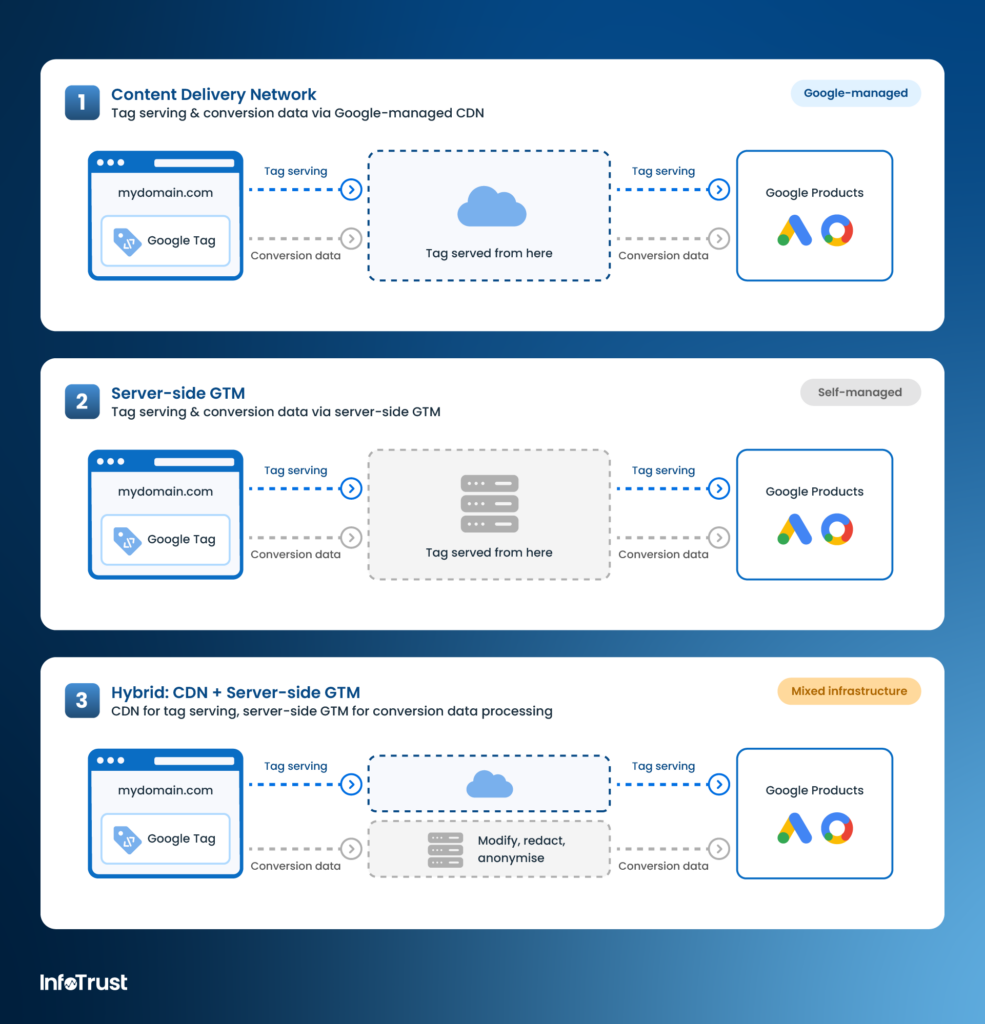
A common question is how Google Tag Gateway differs from a server-side GTM setup. The simplest way to think about it is that first-party measurement has two separate concerns:
Script serving – how tag files (like gtm.js or gtag.js) are loaded.
Data collection – how measurement and conversion hits are sent.
Both Google Tag Gateway (via CDN) and server-side GTM can support these functions. They can also be combined: the CDN serves scripts as first-party resources, while server-side GTM processes and forwards measurement data.
Google Tag Gateway improves tag delivery resilience by making scripts first-party. Server-side GTM improves data control by shifting collection and routing to your server.
At InfoTrust, this hybrid approach is commonly preferred. Tag Gateway improves tag resilience at the browser level, while server-side GTM enables unified server-side data collection across Google and non-Google platforms. Together, they create a more durable and privacy-aligned measurement foundation.
How Tag Gateway Gets Implemented
There are three primary deployment paths:
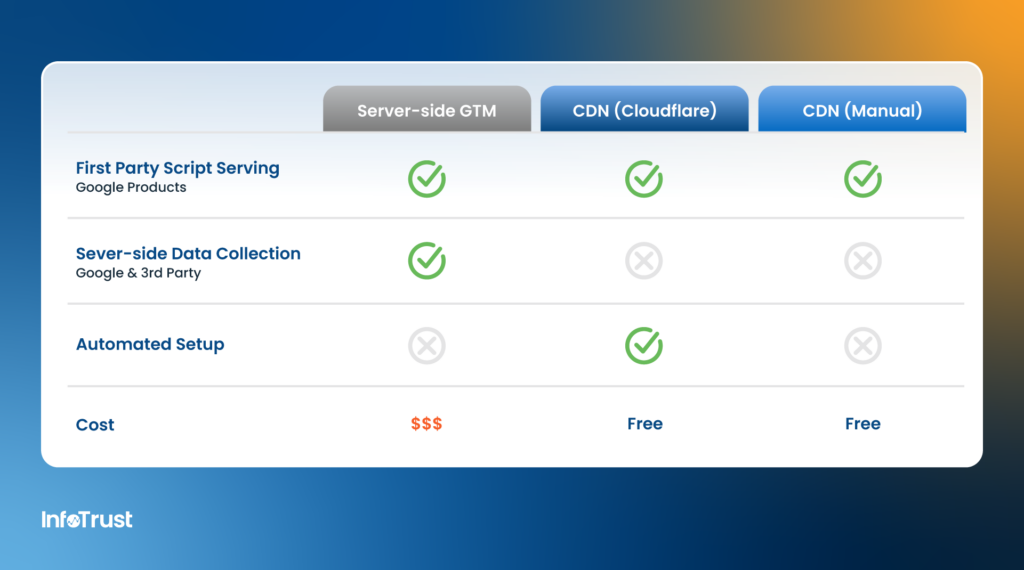
Already using (or planning) server-side GTM
This approach provides the most flexibility. It supports durable server-side data collection, third-party integrations (Meta, TikTok, etc.), and advanced data controls. Google frequently positions Tag Gateway as complementary to server-side tagging for long-term resilience.
Cloudflare environments
For sites running on Cloudflare, Tag Gateway can be enabled through an automated integration. This is typically the fastest deployment path and does not introduce additional media or platform costs.
Other CDNs or web infrastructure
Tag Gateway can also be configured manually. This works across virtually any environment and still enables first-party script serving, though it requires more technical setup.
What Tag Gateway Doesn’t Do
Tag Gateway improves how Google tags are delivered (GA, Google Ads, GTM), but its scope is intentionally narrow.
It does not automatically convert third-party vendor tags into first-party resources. Those require separate handling, often via server-side GTM.
It also does not guarantee bypassing of dedicated ad blockers or override user consent choices. Browser privacy controls, consent frameworks, and Consent Mode behavior still apply.
Tag Gateway reduces certain forms of signal loss, but it is not a universal solution. It is best understood as one component of a broader measurement strategy rather than a standalone fix.
Better Signals (Step 2)
Once tag delivery and data collection are stable, the focus shifts to strengthening signals that drive measurement and optimization. Google’s Data Strength framework highlights high-value identifiers affecting attribution, conversion modeling, and AI performance.
Key signals include User-ID, User-Provided Data, and Transaction ID. These help maintain consistent tracking, improve conversion accuracy, and avoid duplicate counting.
Their effectiveness relies on consistent implementation and proper consent governance. Signal strategy is not about collecting more data, but about capturing decision-relevant identifiers reliably and within privacy and consent requirements.
Stronger AI Performance (Step 3)
Google’s bidding and optimization systems learn from your conversion data. More complete signals lead to more stable optimization.
When conversions are under-reported, the impact extends beyond reporting. Campaigns optimize against incomplete feedback, which can directly affect performance.
Prove your ROI (Step 4)
All measurement approaches, incrementality testing, attribution, or marketing mix modeling, all depend on reliable data inputs.
Improving signal resilience helps ensure that analysis reflects actual user behavior rather than gaps introduced by technical blocking or tag failures.
Where InfoTrust Fits
Google has defined the framework and provided the technology. For most organizations, the real challenge is execution — understanding existing measurement setups, selecting the right architectural approach, and ensuring analytics, tagging, and consent operate together effectively.
Our role as analytics consultants is centered on strengthening the data foundation that performance and measurement depend on. In practice, this spans all four Data Strength steps: evaluating current data collection, designing durable tagging and server-side architectures, configuring signal-enhancing mechanisms such as Enhanced Conversions (using user-provided data) and Consent Mode, and supporting ongoing governance.
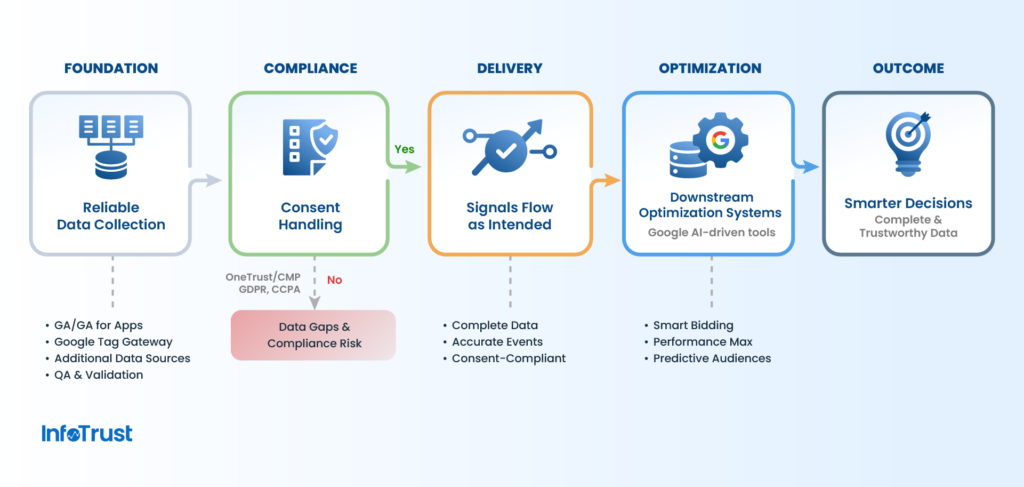
When data collection is reliable, consent handling is correctly implemented, and signals flow as intended, downstream optimization systems — including Google’s AI-driven tools — can operate more effectively. This ultimately allows media and marketing teams to make decisions based on more complete and trustworthy data.
Getting Started
For organizations using Google tech for marketing, analytics and performance, the most effective starting points are typically:
Understand your current state
Identify what is actually implemented, connected, and functioning. Measurement gaps and signal loss often originate from configuration issues rather than platform limitations.
Evaluate Google Tag Gateway in context
Google Tag Gateway directly addresses a growing source of measurement instability by improving first-party tag delivery and reducing browser-level signal loss. For many organizations, this represents a meaningful improvement in data reliability with relatively low implementation overhead.
Review consent management and Consent Mode
Confirm whether Consent Mode is implemented, which configuration is in use, and whether the consent management platform is correctly integrated with the tagging layer. Misalignment here affects not only measurement quality but also regulatory compliance and legal risk.
Plan signal strategy deliberately
Tag delivery and consent handling form the foundation of modern measurement. Signal-enhancing capabilities, including Enhanced Conversions (using user-provided data), and value-based bidding, depend on these mechanisms operating reliably.
Strong data isn’t a feature. It’s a prerequisite.
InfoTrust helps teams move from fragmented measurement to Data Strength, so Google’s AI can optimize with confidence, not guesswork.
Build the foundation once. Benefit from it everywhere.
